What if the future of concrete was hiding in industrial waste?

That’s not a hypothetical. It’s the quietly radical promise of geopolymer technology and the construction industry is only just beginning to pay attention.

For decades, ordinary Portland cement (OPC) has been the backbone of nearly every structure on earth. But it comes with a heavy price: massive greenhouse gas emissions, enormous energy consumption, and a carbon footprint that contradicts every sustainability goal the industry claims to pursue. The search for a real alternative has been ongoing for years. Geopolymer binder may finally be the answer worth taking seriously.


So What Exactly Is a Geopolymer?

At its core, geopolymer is formed by reacting silicon– and aluminium-rich materials often industrial byproducts like fly ash, slag, or metakaolin with an alkaline activator. The result is a non-crystalline silicate gel that hardens into a material with impressive mechanical strength, chemical resistance, and durability.

Think of it as concrete’s smarter, greener cousin. It reuses waste materials that would otherwise end up in landfills, requires significantly less energy to produce, and in some formulations, can reduce CO₂ emissions by over 80% compared to conventional cement.

But there was a catch until recently.


The Problem That Held Geopolymer Back

Traditional geopolymers are made using two components: a solid aluminosilicate precursor and a liquid alkaline activator solution. That liquid activator? Highly corrosive, viscous, and hazardous to handle. Transporting and storing it at scale was a logistics nightmare and a safety one.

This single limitation kept geopolymers largely confined to lab settings and small-scale applications for years. The technology was promising. The practicality wasn’t there yet.

Enter the one-part geopolymer and everything changed.


“Just Add Water”: The Game-Changer

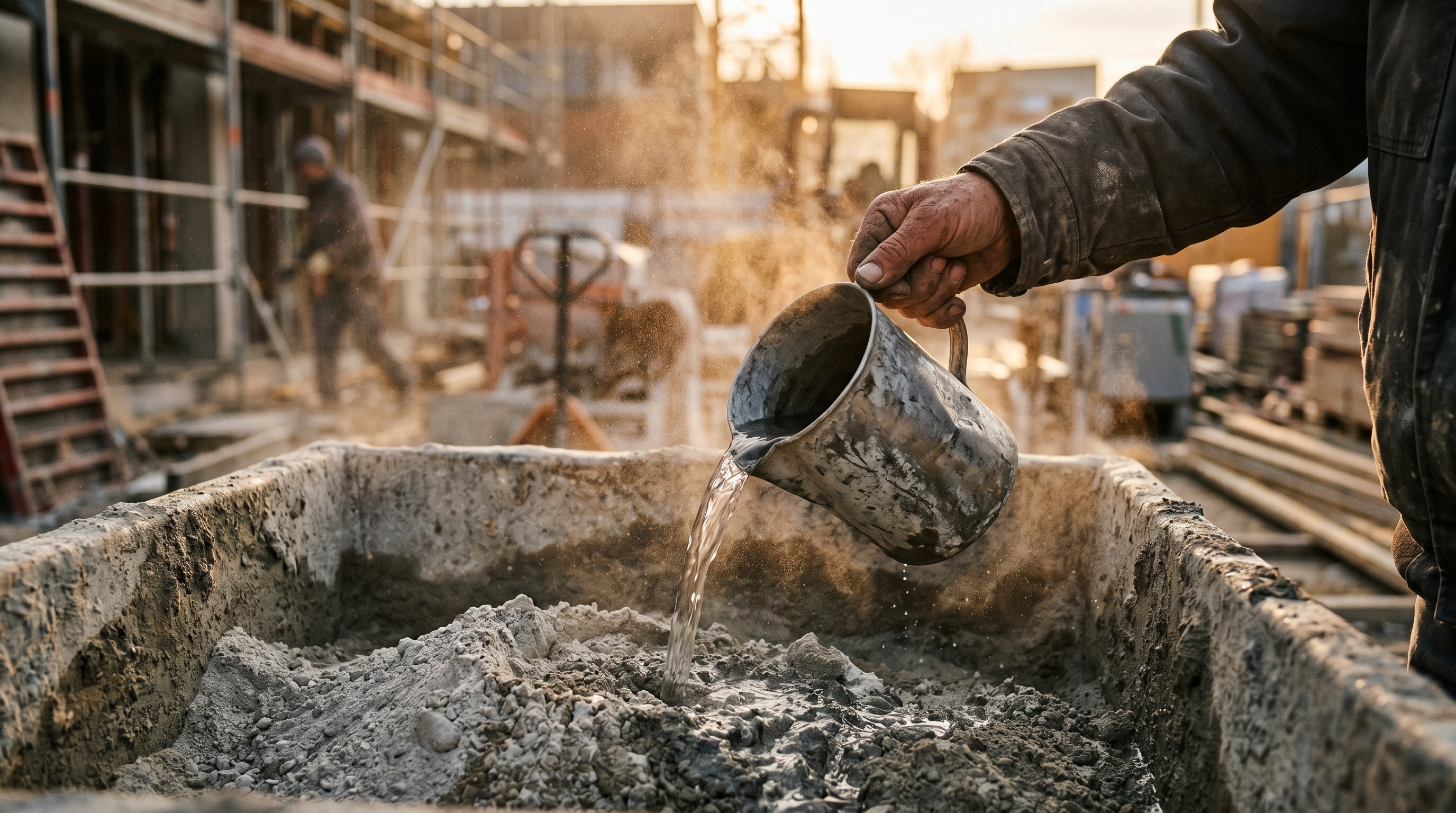
One-part geopolymer binder works exactly like conventional cement powder. Mix the dry components, add water, done. No corrosive liquid activators. No specialised handling equipment. No complex on-site preparation.


It’s produced by blending solid precursors fly ash, ground granulated blast-furnace slag (GGBS), or metakaolin — with solid alkaline activators like sodium metasilicate or sodium carbonate. Water triggers the reaction, forming the same durable geopolymer network, with a process that’s dramatically simpler and safer.

Well-optimised one-part mixes have demonstrated 28-day compressive strengths between 40 and 75 MPa comparable to conventional structural concrete, with a fraction of the environmental cost.


What Goes Into It? The Raw Material Lineup

One of the most compelling aspects of geopolymer technology is what it’s made from  materials most industries consider waste:   

 The raw ingredients of geopolymer: fly ash, slag, metakaolin, red mud, and rice husk ash, every one an industrial byproduct.

        Fly ash : a byproduct of coal combustion, widely available and rich in aluminosilicates

        GGBS : a steel industry byproduct that significantly boosts early-age strength

        Metakaolin : calcined kaolin clay, offering high pozzolanic activity

        Red mud : an alumina production waste that’s both highly alkaline and otherwise environmentally problematic

        Rice husk ash (RHA) : a carbon-neutral super-pozzolan derived from agricultural waste


Each precursor brings something different to the table. Blending them and pairing them with the right solid activator is where the engineering gets interesting. Studies show that a 5:1 GGBS-to-fly-ash ratio can optimise compressive strength significantly.


Where Can It Actually Be Used?

The application list is longer than most people expect, and it’s growing:


        Precast & Structural Construction : Rapid strength development and dimensional stability make it ideal for precast elements, columns, beams, and floor slabs.

        Road Infrastructure : High wear resistance, low permeability, and fast-setting properties make it excellent for pavements, pothole repairs, bridge decks, and runways.

        Fire-Resistant Structures : Inherently non-combustible used in fireproof panels, refractory linings, tunnel fire protection, and heat-resistant structural components.

        Waste Management : Geopolymers can immobilise toxic heavy metals and radioactive materials from industrial byproducts, making them valuable in landfill liners and wastewater systems.

        3D Printing : Tailorable for extrusion-based systems enabling prefabricated building components and complex architectural structures with minimal material waste.

        Tunnels & Underground Construction : Exceptional chemical resistance and low shrinkage make them reliable in subway systems, sewage tunnels, and underground transport networks.

        Repair & Rehabilitation : Stronger, longer-lasting bonds for patching damaged concrete and reinforcing ageing infrastructure bridges, buildings, highways, and marine structures.


The Sustainability Case : By the Numbers

Geopolymer’s environmental credentials go beyond just lower emissions:


        Uses industrial waste as primary raw material directly reducing landfill burden

        Low embodied energy in production

        No high-temperature kiln firing required, unlike OPC

        Ambient temperature curing eliminates the need for energy-intensive processing

        Fully compatible with circular economy principles


The durability angle matters too. Geopolymers’ strong molecular structure built on stable SiO₄, AlO₄ tetrahedral networks means structures last longer, require less maintenance, and generate less replacement waste over their lifetime.


What’s Still Standing in the Way?

It would be dishonest to present geopolymer as a fully solved problem. Several real challenges remain:


Challenge

Detail

Workability

Rapid setting and lower workability compared to OPC is a practical concern on busy construction sites.

Material Variability

Fly ash and slag quality differs by region and source, making consistent performance harder to guarantee at scale.

Standards & Codes

Absence of widely adopted design codes makes many engineers hesitant to specify geopolymer concrete.

Cost

Activators remain more expensive than OPC in certain markets; scaling requires new equipment investment.

Moisture Sensitivity

Solid activators can absorb atmospheric moisture during storage, affecting shelf life and mix consistency.


None of these are insurmountable. Ongoing research into nano-modification, activation strategies, and material optimisation is narrowing the gap rapidly.


The Bigger Picture

The construction industry has operated on the same fundamental chemistry Portland cement, coal-fired kilns, and steel for over a century. Geopolymer technology doesn’t ask it to start over. It asks it to evolve.

The raw materials exist. The performance data is compelling. The manufacturing process is getting simpler with every iteration. What’s needed now is the standardisation, awareness, and industry confidence to move geopolymer from promising research into mainstream specification.

The structures of the next century will need to be built differently. Geopolymer may be one of the most important tools in that transition and the race to scale it up has already begun.


About the authors :  S. K. Singh Chief Scientist                                 Yasmeen Qureshi

                                   CSIR-Central Building Research Institute,         Project Associate-II      

                                   Roorkee - 247667, Uttarakhand, India