The engineering failure happened long before the structural one.
The recent incidents in Mumbai, Pune, and Chandigarh follow a pattern structural engineers recognise immediately. Not because the collapses were inevitable. Because the deterioration that caused them was visible, measurable, and addressable years before the structure reached a critical state.
What the warning signs look like:
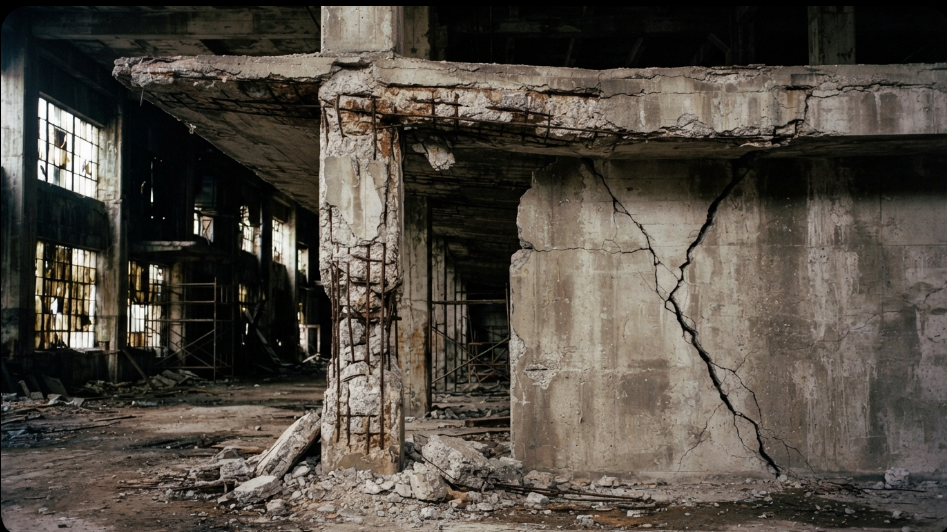
Cracks in structural members. Concrete spalling at column bases. Rust stains running down facades. Exposed reinforcement with visible section loss. Water seeping through slabs. Excessive deflection. Foundation settlement at door frames. These are not maintenance issues. They are clinical indicators of structural distress the same way chest pain is not a comfort issue, it is a medical indicator. The problem: most building owners interpret these signs through a cost lens. The crack gets painted over. The rust stain gets washed. The seepage gets a temporary patch. The deterioration continues underneath.
The question that should follow every collapse:
Not "why did it fall?" but "when was it last professionally assessed?"
Not inspected by a contractor looking for repair work. Assessed by a structural engineer visual distress mapping, NDT, material strength evaluation, corrosion assessment, residual life analysis.
A structural audit answers one question: what is the actual condition of this structure, and what does it need to remain safe?
That question, asked regularly and answered honestly, is what prevents collapses. Not stronger materials. Not revised codes. Regular, professional assessment of existing structures which India has no mandatory framework for across most of its building stock.
The rehabilitation reality:
Deterioration caught early: targeted, economical intervention crack injection, corrosion mitigation, concrete repairs, waterproofing. Structure restored at a fraction of reconstruction cost. Deterioration caught late: jacketing, retrofitting, or demolition. Orders of magnitude more expensive and disruptive. The cost of a structural audit is measured in lakhs.
The conversation that needs to happen:
India's building stock is ageing. Millions of structures built in the 1970s, 80s, and 90s with construction practices and cover standards unacceptable today are occupied daily without systematic assessment of their structural condition
Author : Buildonomics Research Team