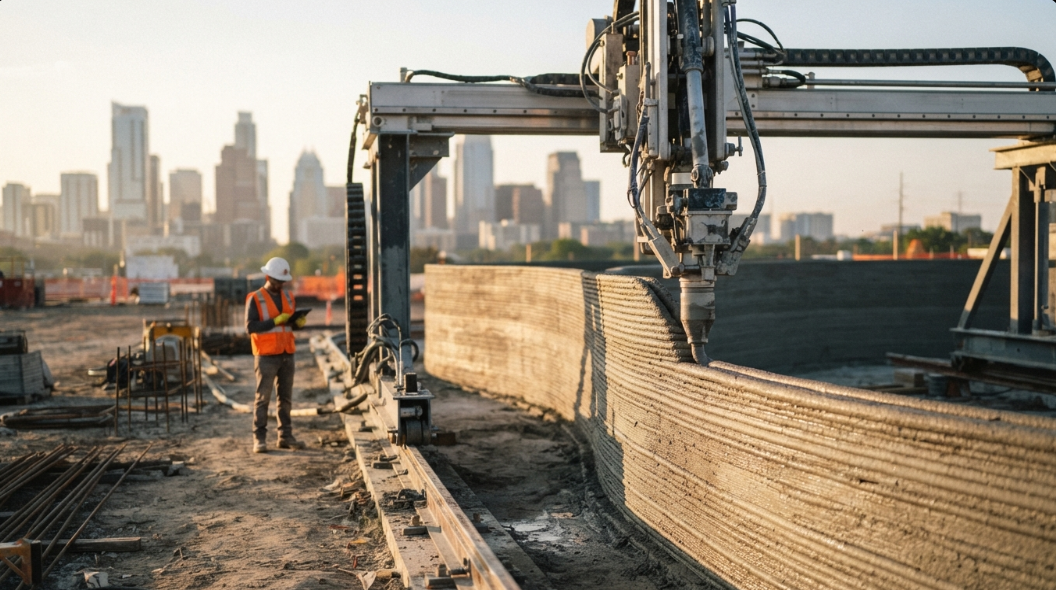
3D printing, also known as additive manufacturing, has emerged as a transformative technology in the construction industry, particularly in concrete construction. By using specialized printers and concrete mixtures, this method allows structures to be built layer by layer, eliminating many traditional construction processes.
Key Aspects of 3D Printing in Concrete Construction:
1. Technology and Process
3D Printers: Large-scale printers such as gantry-style or robotic arm printers are used to extrude concrete.
Materials: Specially formulated cement-based materials or geopolymer concretes ensure appropriate flowability, setting time, and structural integrity.
Layer-by-Layer Construction: The printer follows digital models, layering the material precisely, resulting in reduced waste and optimized designs.
2. Applications
Residential Buildings: Entire houses can be printed in days, reducing time and labor costs.
Infrastructure: Bridges, retaining walls, and urban furniture have been successfully created using 3D printing.
Complex Geometries: Architects and designers can explore intricate designs that are difficult or impossible with traditional methods.
3. Advantages
Cost Efficiency: Reduces material waste and labor requirements.
Speed: Faster construction compared to traditional methods.
Sustainability: Reduces CO₂ emissions through optimized material use and potential incorporation of recycled materials.
Customization: Enables the creation of unique, site-specific structures.
4. Challenges
Material Limitations: Concrete for 3D printing requires precise formulations, and long-term performance data is still limited.
Standardization: Lack of established codes and regulations.
Equipment Costs: High initial investment in 3D printing technology.
Skilled Workforce: Requires training to operate and maintain advanced equipment.
5. Future Trends
Integration of Reinforcement: Combining 3D printing with methods to incorporate reinforcement, such as steel bars or fibers, for improved strength.
Automation and Robotics: Enhanced automation can streamline construction processes further.
Sustainable Materials: Increased use of environmentally friendly materials like recycled aggregates and low-carbon cements.
Scaling Up: More widespread adoption in large-scale projects and urban developments.
Case Studies
Dubai Municipality's Office Building: Recognized as the world’s largest 3D-printed building, showcasing the potential of this technology in urban settings.
ICON’s 3D-Printed Homes: This startup has developed affordable 3D-printed housing in the U.S. and Mexico.
3D-Printed Bridges: Examples include pedestrian bridges in Europe and Asia, demonstrating feasibility for infrastructure.
Conclusion
3D printing in concrete construction holds great promise for revolutionizing the industry, making it faster, cheaper, and more sustainable. While there are challenges to overcome, ongoing advancements in materials science, robotics, and design methodologies will likely ensure its growth as a mainstream construction technique.
About the author: Buildonomics Research Team