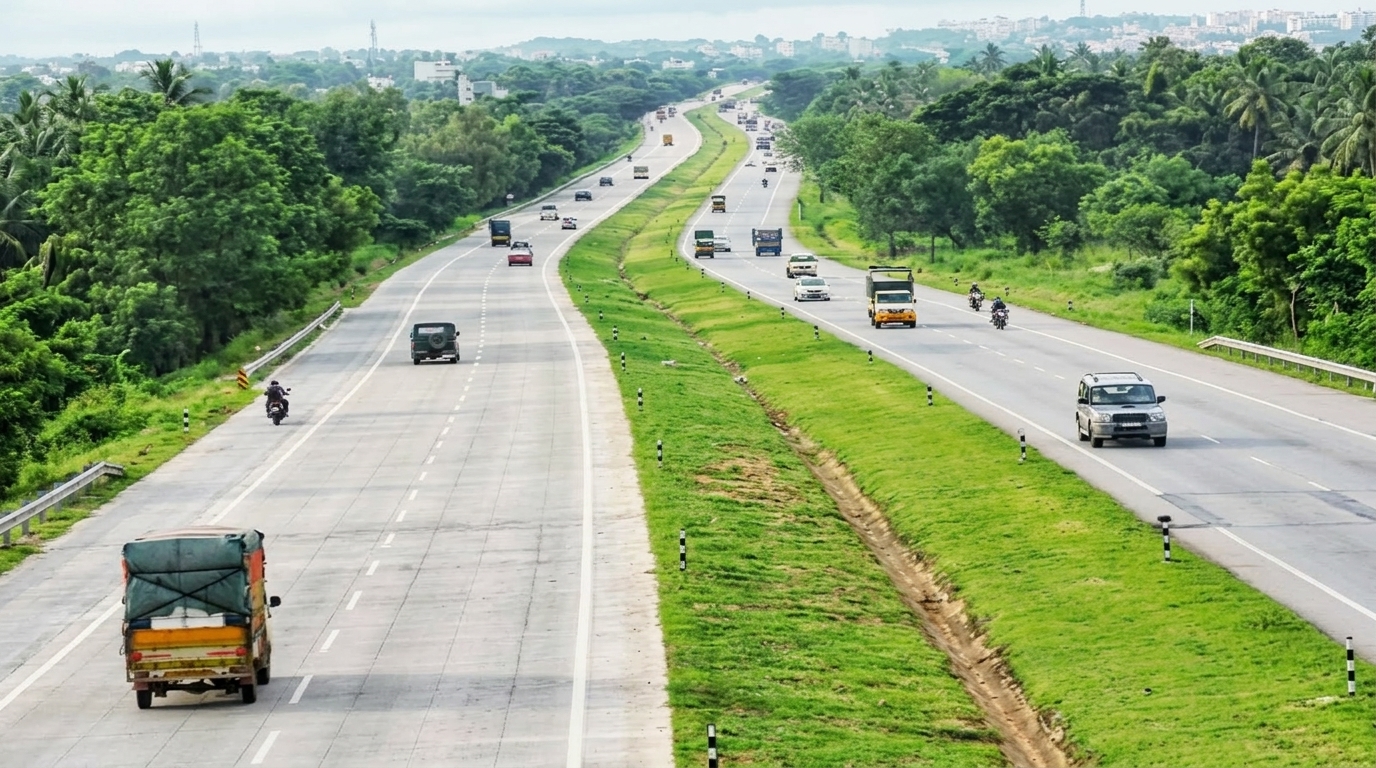
Every time it rains, thousands of accidents happen. Every time a truck rolls over a pothole, fuel burns unnecessarily. Every summer, urban temperatures creep higher. And every few years, road crews tear up the same stretch of asphalt and lay it down again.
What if there was a road surface that lasted 40 years with almost zero maintenance and actually made cities cooler, safer, and cheaper to run?
There is. It’s called White Topping and India has already built over 5,000 lane kilometres of it.
What Is White Topping, Exactly?
White Topping is a concrete overlay laid directly over an existing asphalt road no demolition, no sub-base preparation. A thin slab of high-performance concrete, typically 150mm thick, is placed on top of the worn asphalt surface and left to do what concrete does best: last.
Demo projects were built across Bengaluru, Jaipur, Chennai, and Hyderabad starting in 2010, designed to IRC: SP 76 2008 standards. Over a decade later, roads built during those first trials are still performing with zero maintenance.
That’s not a claim. That’s a decade of real-world data.
The Road That’s Been Running Since 1939
Want proof that concrete roads last? Look at Marine Drive, Mumbai. The concrete pavement along one of India’s most traffic-heavy urban corridors was built in 1939. It is still carrying some of the highest traffic volumes in the country today over 80 years later, without replacement.
Compare that to an asphalt road:
• Maintenance required every 2 to 4 years
• Full resurfacing every 8 to 10 years
• Total lifespan before major rehabilitation: roughly 15 to 20 years
A White Topped concrete road? Minor rehabilitation at 10 to 12 years if heavily used. No resurfacing needed for 30, 40, even 50 years.
|
That’s not just a materials difference. That’s a fundamentally different relationship between infrastructure and cost. |
The Numbers That Change the Conversation
White Topping costs about 30% more upfront per kilometre than asphalt. Critics stop there. They shouldn’t. Over 20 years, the total cost picture looks like this:
|
|
Asphalt Overlay |
Concrete Overlay |
Saving |
|
Initial Cost / km |
₹84.39 lakhs |
₹110.25 lakhs |
— |
|
Maintenance binder (20 yrs) |
₹181.5 lakhs |
₹0 |
₹181.5 lakhs |
|
Aggregate for renewals (20 yrs) |
₹26.48 lakhs |
₹0 |
₹26.48 lakhs |
|
TOTAL — 20 YEARS |
₹292.37 lakhs |
₹113.25 lakhs |
61% LESS |
The road that costs more on day one costs 61% less over 20 years. That’s the conversation infrastructure planners need to be having.
The Fuel Economy Nobody Accounts For
Heavy vehicles on asphalt experience measurably greater pavement deflection the road flexes slightly under load, and that flex costs energy. On rigid concrete, that deflection is dramatically reduced.
Studies show this translates to a 14% fuel saving for goods vehicles on White Topped roads. Scale that across India’s 2.8 million trucks each running approximately 60,000 km per year and the numbers become extraordinary:
• ₹47,040 crores saved in diesel costs annually
• 161 lakh MT of CO₂ eliminated
• 1.84 lakh MT of NOx removed from the atmosphere
|
That diesel saving alone could fund the construction of 47,000 km of new White Topped roads every single year. The road pays for itself in fuel it saves other people. |
Safer Roads, By Design
Road safety isn’t just about speed limits and signage. The surface itself matters enormously. Around 14% of all road crashes occur in wet weather. Research suggests 70% of those wet-weather crashes could be prevented by replacing asphalt with concrete overlays.
Braking distance on a dry concrete surface, a car stops in roughly 162 feet. On dry asphalt, 190 feet. On wet rutted asphalt? 440 feet nearly three times longer.
Reflectivity: concrete surfaces reflect 4 to 5 times more light than asphalt. Drivers see hazards sooner. Pedestrians are more visible. Night-time accident rates fall.
Street lighting: to achieve the same illumination as a concrete road, an asphalt road requires either 24% more light poles or significantly higher wattage bulbs at every existing pole. Either way, the asphalt road costs more energy, every single night, forever.
The Urban Heat Problem Concrete Quietly Solves
India’s cities are getting hotter. The urban heat island effect: where dense urban surfaces trap and radiate heat is responsible for 5 to 10% of peak urban electricity demand, just for air conditioning.
Asphalt roads are a major contributor. Infrared imaging shows asphalt surfaces reaching 62°C in Indian summer conditions. Concrete under identical conditions stays below 58°C and its reflective surface bounces solar radiation back rather than absorbing and re-radiating it as heat.
Concrete is naturally brighter. Up to 27% of light falling on a concrete surface reflects back upward. On asphalt, as little as 5% does. Cooler roads mean cooler cities, lower electricity bills, reduced AC load, and fewer heat-related health incidents.
It’s Already Green And Getting Greener
White Topping concrete mixes routinely incorporate fly ash, GGBS (ground granulated blast furnace slag), and silica fume industrial byproducts that would otherwise require disposal. Replacing 20 to 50% of cement with these materials enhances performance while significantly cutting embodied carbon.
A study comparing concrete with 50% GGBS replacement showed a 35% reduction in embodied energy and a 45% reduction in greenhouse gas emissions per cubic metre compared to standard concrete.
On the LEED green rating scale: Concrete overlay scores 61 out of 100. Asphalt scores 30. That’s not a marginal difference. That’s a different category entirely.
And when a White Topped road finally reaches the end of its design life, decades from now the concrete is 100% recyclable, crushable into granular fill or sub-base material for new pavements.
The Road Ahead
The evidence is in. The data is public. The demo projects have run for over a decade in Indian conditions and delivered exactly what was promised.
White Topping isn’t a niche technology waiting for proof. It’s a proven solution waiting for wider adoption.
Every kilometre of asphalt road that gets resurfaced this year is a missed opportunity. Every pothole that gets patched instead of permanently fixed is money spent twice. And every year that passes without converting high-traffic urban corridors to concrete is a year of excess fuel burned, excess emissions released, and excess accidents that didn’t need to happen
About the author : G. Sreenivasa, Former VP and Head- White Topping and RMD Technologies,
Ultratech Cement Limited
|
The question isn’t whether White Topping works. The question is: why aren’t we building more of it? |
|
Interested in infrastructure technologies reshaping how India builds and moves? Stay tuned to BUILDONOMICS for more deep-dives into the innovations transforming our cities. |