India has the tools to capture the land value created by public infrastructure. But restrictive FSI rules, weak property valuation and outdated urban-finance models are pushing development outward instead of upward.
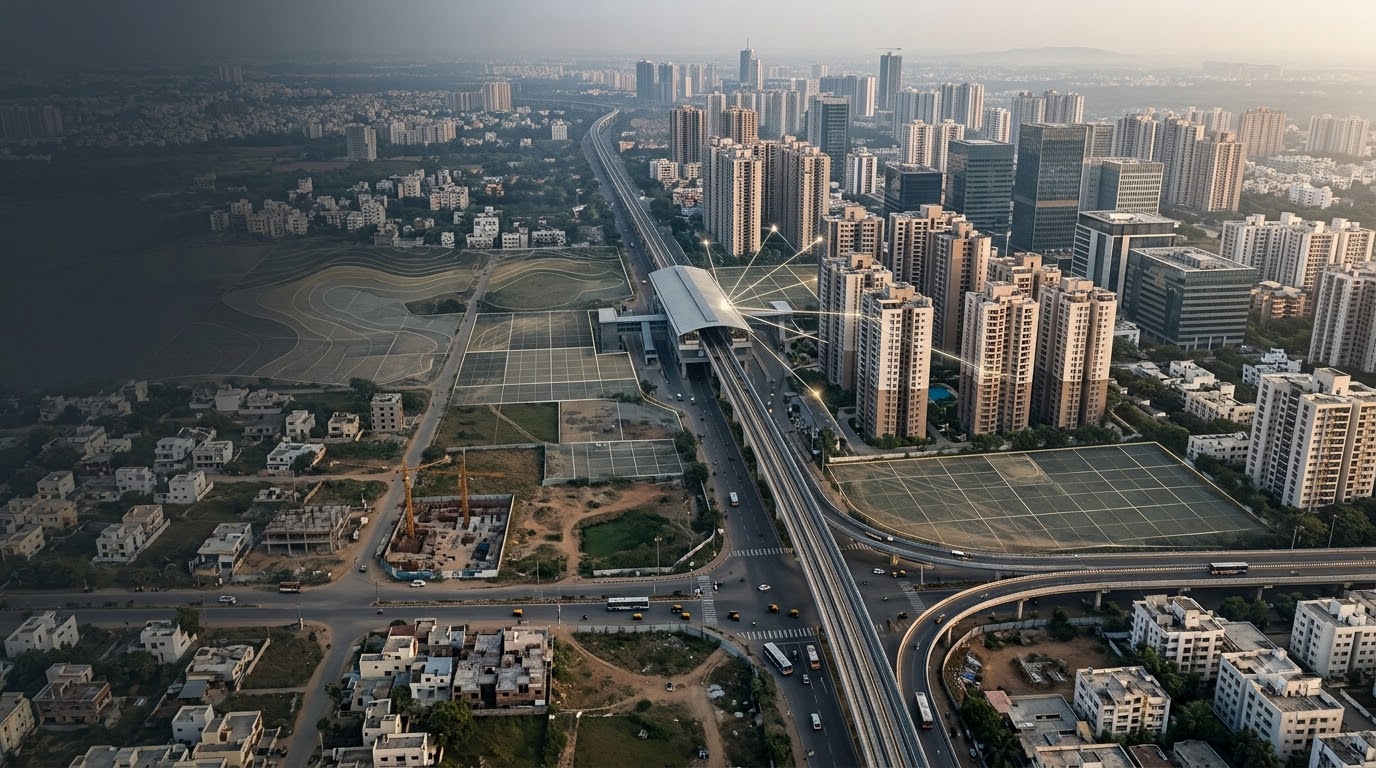
When a metro line, highway, airport or new urban corridor reaches an area, something predictable happens.
Accessibility improves.
Land becomes more valuable.
The interesting question is: who captures that increase in value?
In most Indian cities, the answer is largely the landowner.
The government spends public money to create infrastructure. The surrounding land benefits from better connectivity and access. But the increase in land value is rarely captured systematically and redirected towards the infrastructure that created it.
This is the central idea behind land value capture (LVC).
And it matters far beyond municipal finance.
It directly affects housing affordability, urban density, infrastructure funding and the physical expansion of Indian cities.
Infrastructure creates value beyond the project boundary
Consider a vacant plot located near a future metro station.
Before the metro, the location may have been desirable but relatively ordinary.
Then the government announces a metro alignment.
Station locations become known.
Construction begins.
Eventually, trains start operating.
The owner of the plot may have done absolutely nothing to improve the property. Yet its market value can rise substantially because accessibility has improved.
The infrastructure investment has effectively created a location premium.
That is the value governments are trying to capture.
Land value capture does not necessarily mean imposing another conventional tax. It can take several forms, including premium FSI, betterment charges, land pooling, development rights and infrastructure-linked levies.
The objective is simple:
A portion of the value created by public investment should help finance public infrastructure.
When cities cannot grow compactly, they grow outward
There is a simple urban equation:
Expensive central land + restricted development = pressure to move outward.
Households looking for affordable housing eventually move further from employment centres.
Developers look for cheaper land.
Agricultural and peripheral land gets converted.
New layouts appear at the edge of the metropolitan region.
And infrastructure has to chase development.
Roads, water supply, drainage, sewage networks and public transport must then be extended to these new areas.
This creates a costly cycle.
Instead of concentrating growth around existing infrastructure, cities keep expanding their infrastructure footprint.
Bengaluru provides a powerful illustration of this phenomenon.
The city's built-up area has expanded dramatically over the past few decades, while the metropolitan region continues to face challenges related to water, mobility and civic infrastructure.
The result is a city that becomes physically larger without necessarily becoming proportionately more efficient.
The bigger problem is India's weak land-value data
You cannot efficiently capture value that you cannot measure.
This is one of the biggest structural weaknesses in Indian urban finance.
Property transaction information, guidance values, planning information and infrastructure investments often sit within different government systems.
As a result, cities may know that a metro station was constructed.
They may know where the station is.
They may know how much the project cost.
But they often lack an integrated system showing:
-
What properties benefited?
-
How much did their values increase?
-
How quickly did values change?
-
Which properties benefited most?
-
How much additional development became possible?
-
What portion of the increase should reasonably be captured?
International research demonstrates that infrastructure can produce measurable land-value effects.
Studies around Delhi Metro corridors, for example, have identified increases in residential and commercial property values close to stations.
The implication is important.
Land-value capture does not have to be a blind tax. It can be designed around measurable changes in accessibility and property values.
The Urban Challenge Fund changes the equation
The issue has become more urgent because India's urban infrastructure financing requirements are growing rapidly.
The Centre's ₹1 lakh crore Urban Challenge Fund creates an additional incentive for cities to improve their ability to raise and leverage capital.
For urban local bodies, own-source revenue is increasingly important because market borrowing, municipal bonds and other financing mechanisms depend on credible municipal finances.
That creates a potential chain:
Infrastructure → higher accessibility → higher land value → value capture → stronger municipal revenue → greater borrowing capacity → more infrastructure.
If designed correctly, this can become a positive cycle.
If designed badly, cities can fall into the opposite cycle:
Low revenue → weak infrastructure → outward expansion → higher servicing costs → weaker municipal finances.
India's urban growth needs two simultaneous reforms
The first is better value capture.
Cities need mechanisms that can identify infrastructure-generated increases in land value and recover a reasonable portion of that gain.
The second is better development regulation.
Where infrastructure capacity exists, cities should be able to accommodate significantly more people and economic activity through appropriate increases in development intensity.
These are two sides of the same problem.
Land-value capture answers: who receives the value created by public infrastructure?
FSI and development regulations answer: how many people can benefit from that infrastructure?
India needs both.
Otherwise, cities risk continuing the same cycle: expensive central land, restricted development, peripheral expansion, longer commutes and increasingly expensive infrastructure networks.
The objective should not simply be to make Indian cities bigger.
It should be to make them more compact, better connected, financially sustainable and capable of housing more people near opportunity.
The next phase of India's urbanisation will depend not only on how much infrastructure the country builds.
It will depend on how intelligently that infrastructure, the land around it and the rules governing development are connected.
- Buildonomics Staff