The next major shift in construction equipment may not be driven by sustainability. It may be driven by economics.
For decades, diesel was the obvious choice. The machines were proven, refuelling infrastructure was everywhere, and the upfront cost was relatively predictable.
Electric equipment changes that calculation. The purchase price is often higher. But energy, maintenance and downtime can be lower.
So the real question isn't: “Is electric equipment more expensive?”
It is: “What will this machine actually cost over its working life?”
Purchase Price Is Only the Beginning
For fleet owners, the real cost of equipment includes:
Capital + Energy + Maintenance + Downtime + Infrastructure − Residual Value
A diesel machine may win on purchase price but lose over thousands of operating hours because of fuel and maintenance costs. An electric machine may start with a higher capital cost but potentially recover that premium through lower operating costs.
That makes cost per productive hour a more useful metric than purchase price alone.
Utilisation Determines the Business Case
Electric doesn't automatically make economic sense. A machine operating only a few hundred hours per year may struggle to recover its higher upfront cost.
A machine operating 1,500–2,000+ hours annually has a very different equation.
For example: 1,800 hours/year × 5 years = 9,000 operating hours.
Even a modest saving per operating hour can become significant over that lifecycle.
This is why fleet managers should ask: Which machines have the utilisation and duty cycle to justify electrification?
not simply - Should we electrify the fleet?
Where Electric Is Already Attractive
The strongest opportunities are generally equipment with predictable duty cycles and manageable energy requirements.
Examples include:
-
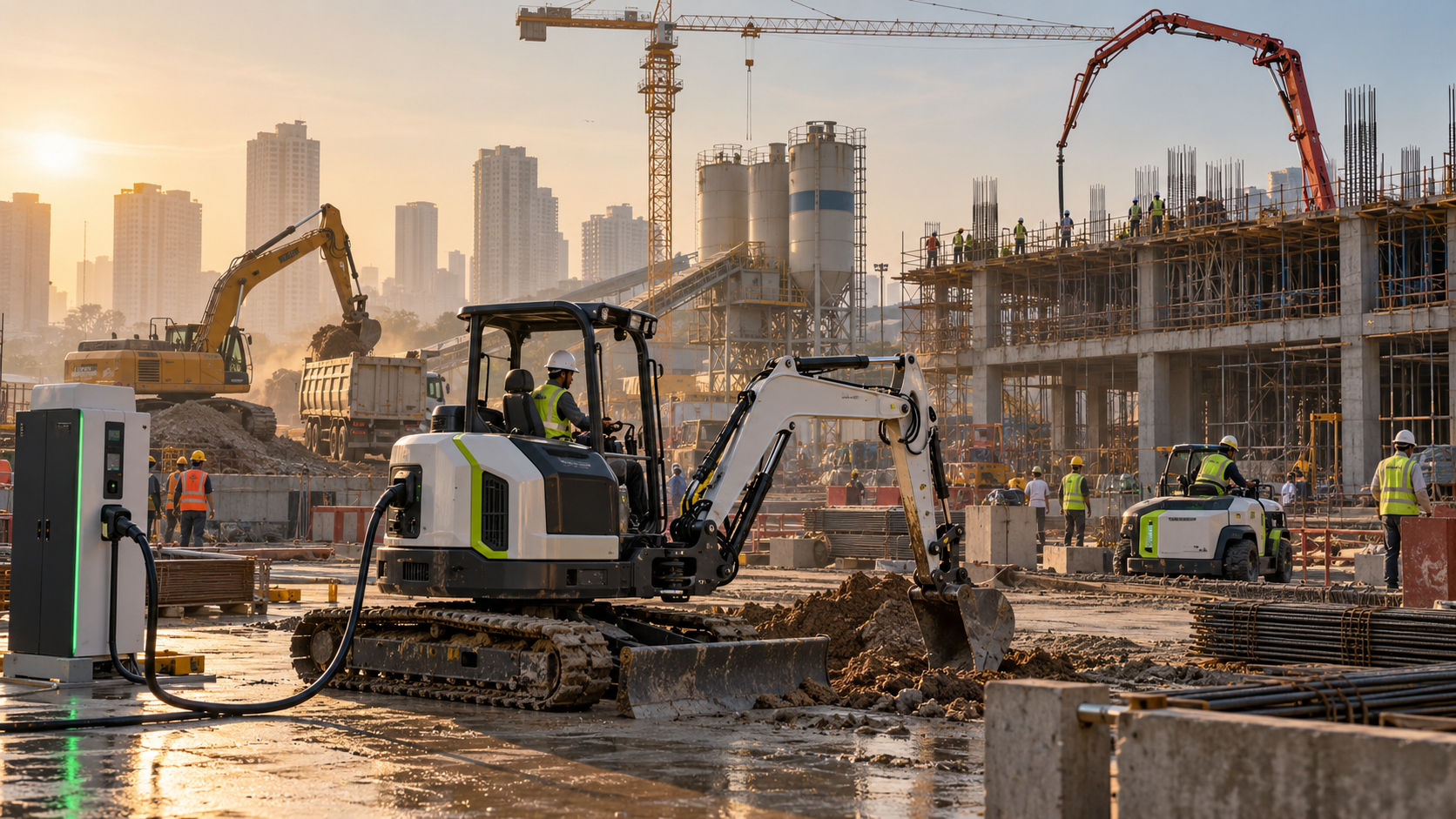
Compact excavators
-
Scissor lifts and AWPs
-
Material hoists
-
Lighting towers
-
Smaller compactors
-
Small loaders
-
Certain mixers and site-handling equipment
Urban construction can be particularly suitable because charging can be planned and reduced noise and zero tailpipe emissions can have practical value.
Where Diesel Still Makes Sense
Electric hasn't solved every construction application. Large excavators, long-haul dump trucks, remote infrastructure projects and sustained high-load operations still face challenges around battery capacity, charging time, grid access and energy requirements. For these applications, the transition may be:
Diesel → Hybrid → Electric
rather than diesel directly to full electric. Hybrid equipment can reduce fuel consumption while using batteries and electric motors to handle peak power requirements. For many heavy-duty applications, that could be the practical bridge.
Charging Is Part of the TCO
An electric machine isn't economical if it spends productive hours waiting for energy. The business case must therefore include:
-
Grid capacity
-
Charger cost
-
Charging time
-
Battery capacity
-
Electricity tariffs
-
Backup power
-
Site layout
-
Number of machines
This means electrification isn't simply an equipment decision.
It's an equipment + energy + site-planning decision.
India's Equation Is Different
India's construction fleet has another layer of complexity. Urban projects may have relatively good access to electrical infrastructure. Remote highways, mining projects and large infrastructure developments may not. Therefore, Indian contractors need to evaluate:
Utilisation + Diesel price + Electricity cost + Grid availability + Charging infrastructure + Financing + Residual value
for every equipment category. There is no single electrification strategy that works for every project.
What Should Fleet Managers Do?
Don't replace the entire fleet. Start with the data.
1. Measure utilisation
How many productive hours does each machine actually deliver?
2. Calculate cost per hour
Include fuel, electricity, maintenance and downtime.
3. Identify high-utilisation assets
These are the machines most likely to justify a higher upfront investment.
4. Assess charging feasibility
Especially for urban versus remote projects.
5. Compare five-year TCO
Not just purchase price.
6. Pilot before scaling
Use real project data to validate the economics.
The Real Question
The construction-equipment transition isn't simply about choosing between diesel and electric.
The better question is: Which machine, on which project, at what utilisation, with what energy infrastructure, produces the lowest lifecycle cost?
Some machines will remain diesel. Some will become hybrid. Some will move directly to electric. The transition will happen machine by machine, site by site and fleet by fleet. And that is why construction electrification should not be viewed only as an environmental story. It is increasingly a procurement, productivity and economics story. The future of construction equipment may be electric.
- Buildonomics Research Team