A building can have efficient HVAC and still waste energy. The problem is often in the walls, roof, glass, or concrete not the mechanical systems.
The building envelope is the first line of defence. And material specification is an energy-performance decision, not a procurement one.
The Envelope Controls the Load
A building constantly exchanges heat with its surroundings. The envelope determines how much of that heat reaches occupied space.
Solar heat + conduction + air infiltration → indoor heat gain → cooling demand
Every material decision in the envelope influences one or more of these pathways.
Insulation: Stop Heat Before HVAC Removes It
Low thermal conductivity materials mineral wool, EPS, XPS, PIR, AAC, sandwich panels reduce conductive heat transfer. But specifying by R-value alone is insufficient.
What actually determines performance in practice:
Thickness + continuity + thermal bridging + installation quality
A high-performance insulation layer interrupted by structural elements or poorly sealed joints loses most of its benefit before the building is occupied.
The Roof: India's Biggest Heat Gain Surface
In hot climates, the roof absorbs intense solar radiation for long periods. A dark roof becomes significantly hotter than ambient air driving heat directly into the occupied space below.
Cool-roof strategies reduce this:
Higher solar reflectance → lower surface temperature → lower heat gain
Roof reflectance works best when combined with adequate insulation, not as a standalone solution.
Glass: An Invisible Cooling Load
The relevant question is not whether glass is double-glazed. It is how the complete glazing system performs in this climate and orientation.
What matters:
- Solar Heat Gain Coefficient (SHGC)
- Low-E coatings
- External shading
- Window-to-wall ratio
In hot climates, low-SHGC glazing combined with external shading can significantly reduce cooling load without eliminating daylight.
Concrete and Thermal Mass
Concrete absorbs and stores heat moderating indoor temperature swings. But thermal mass is not automatically energy efficiency.
Its effectiveness depends entirely on climate, occupancy pattern, night-time temperatures, ventilation strategy, and how the building is operated. A massive concrete wall in the wrong configuration adds load, not efficiency.
Thermal Bridges: Where Good Specifications Fail on Site
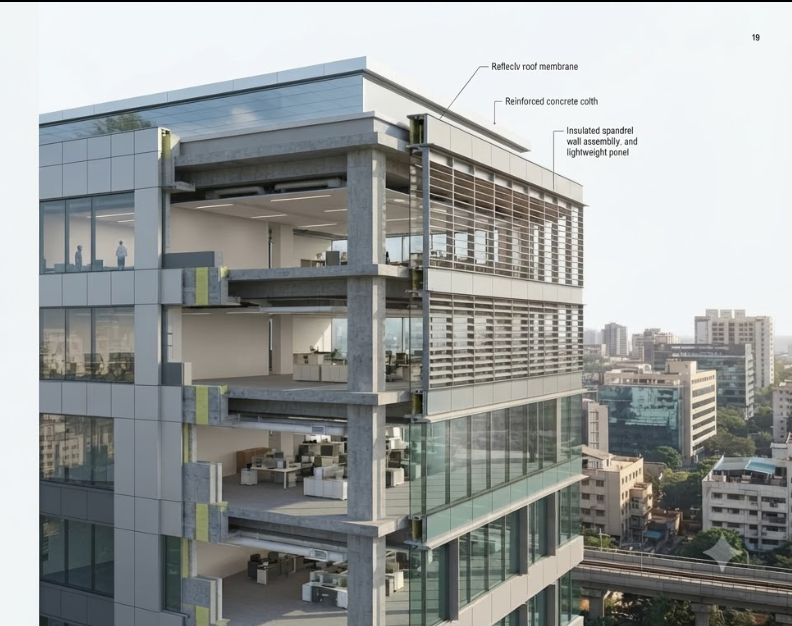
A well-insulated wall interrupted by concrete columns, beams, or slab edges creates thermal bridges pathways where heat bypasses insulation through more conductive elements.
For high-performance buildings, thermal-bridge detailing is as important as the insulation product itself. This is where laboratory performance and site performance diverge most significantly.
Climate First, Material Second
There is no universal green material. The right specification depends on climate, orientation, occupancy, and operating hours. A strategy appropriate for hot-dry conditions may perform poorly in a humid coastal environment.
Climate-responsive design must precede material selection not follow it.
Beyond Operational Energy
Reducing electricity consumption is not the complete picture. Whole-life impact matters:
- Embodied carbon in manufacture and transport
- Service life and replaceability
- End-of-life recyclability
A building can have low operational energy while carrying significant embodied carbon. The real objective is lower whole-life environmental impact.
- Buildonomics research team