Here is something that surprises most engineers when they first encounter it.
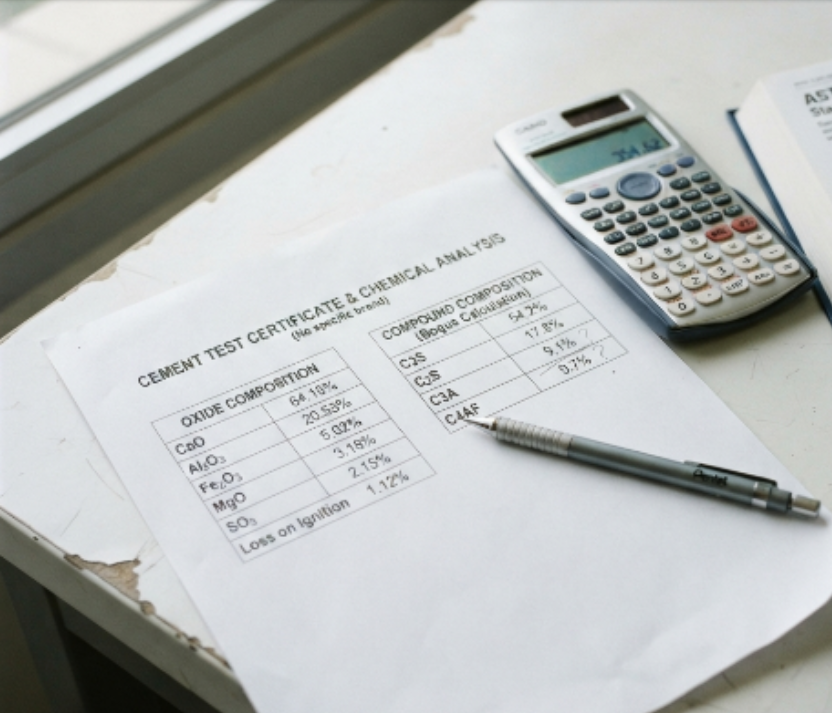
The compound composition on your cement test certificate the C3S, C2S, C3A, C4AF values that determine heat of hydration, strength development, and sulfate resistance is almost never determined by direct measurement.
It is calculated from the oxide analysis using a set of equations developed by R.H. Bogue in the 1920s.
What the Bogue calculation actually does:
X-ray fluorescence analysis measures the elemental oxide composition of cement CaO, SiO2, Al2O3, Fe2O3, MgO, SO3, and others. These are direct measurements.
The Bogue equations then calculate the theoretical compound composition from those oxides assuming the clinker reached full equilibrium during burning and that the compounds are in their pure, ideal form.
The four Bogue equations:
→ C3S = 4.071(CaO) − 7.600(SiO2) − 6.718(Al2O3) − 1.430(Fe2O3) − 2.852(SO3)
→ C2S = 2.867(SiO2) − 0.7544(C3S)
→ C3A = 2.650(Al2O3) − 1.692(Fe2O3)
→ C4AF = 3.043(Fe2O3)
Why it's an estimate not a measurement:
The Bogue calculation carries three fundamental assumptions that are never fully satisfied in practice.
First, it assumes the clinker reached complete chemical equilibrium during burning. Real kiln conditions are dynamic temperature gradients, residence time variations, and cooling rates mean that true equilibrium is rarely achieved.
Second, it assumes the compounds exist in their pure, stoichiometric form. In reality, C3S in clinker always contains small amounts of Mg, Al, and other elements in solid solution which changes its reactivity compared to pure C3S.
Third, it assumes no unreacted free lime or glass phases are present. Both are present in real clinker to varying degrees.
The result: Bogue calculations can underestimate actual C3S content by 5–10 percentage points and overestimate C2S by similar margins in some cements. For C3A the compound most critical for sulfate resistance the error can be directionally significant even if numerically small.
What this means for how you use the data:
The oxide analysis on the certificate is reliable those are measured values from XRF.
The compound composition is a model output it is as good as the model's assumptions, which are approximately correct for most cements under most conditions.
For routine specification and quality monitoring, Bogue values are adequate. The relative comparison between cement batches is this batch higher in C3A than the last one? is useful and directionally correct.
For critical applications sulfate-resistant concrete, mass concrete with strict heat limits, or any situation where compound composition is the primary selection criterion Bogue values should be supplemented with direct microscopic analysis (quantitative X-ray diffraction, optical microscopy of polished sections) where the stakes justify it.
The practical implication:
When a cement certificate shows C3A = 3.5% and you're specifying sulfate-resisting cement, you are relying on a calculated value, not a measured one.
That doesn't make the specification wrong. It means you should understand what confidence level you're actually working with and design your quality monitoring accordingly.
Data is only as reliable as the method that produced it. Knowing which numbers on a cement certificate are measurements and which are calculations is fundamental to interpreting that certificate correctly.
Author : Buildonomics Research Team