Portland cement is not one compound. It is four.
Each one behaves differently when water arrives. Each one contributes something different to the concrete you pour. And the ratio between them fixed at the factory, invisible in the bag determines more about your concrete's performance than any site decision you will make.
Here's what's actually inside:
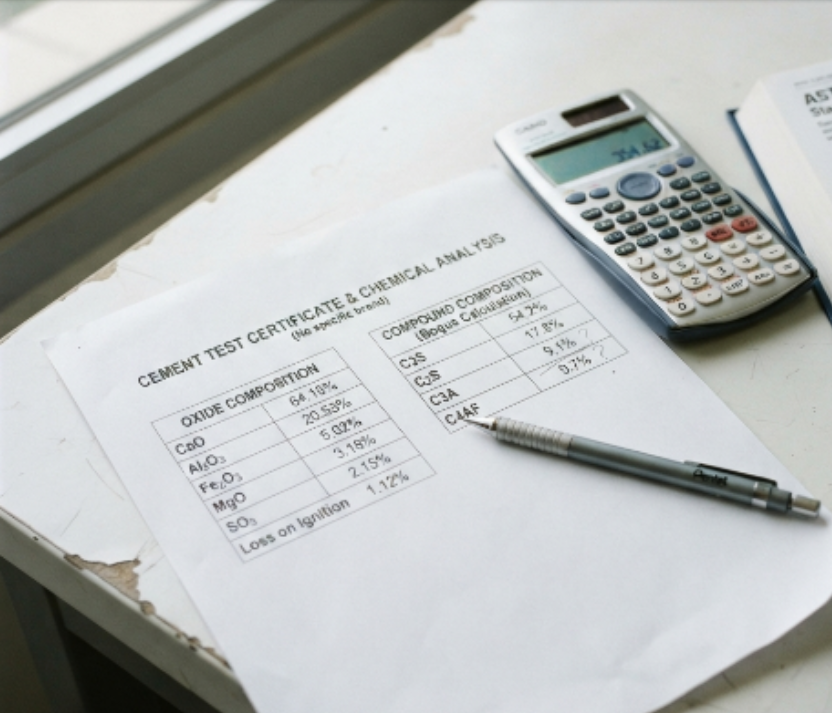
C₃S : Tricalcium Silicate (50–70% of OPC) The workhorse. C₃S hydrates rapidly, generates significant heat, and is primarily responsible for strength in the first 28 days. When your cube test result at 7 days looks strong, C₃S is the reason.
C₂S : Dicalcium Silicate (15–30%) The long game. C₂S hydrates slowly contributing little in the first week, meaningfully at 28 days, and continuing to gain strength for years. Structures that keep getting stronger at 6 months and 1 year have C₂S to thank.
C₃A : Tricalcium Aluminate (5–10%) The problem compound. C₃A hydrates almost instantly, generates the most heat of any compound, and is primarily responsible for flash set if uncontrolled. Gypsum is added during cement manufacture specifically to slow C₃A hydration. In sulfate-aggressive environments, C₃A is also the compound that reacts destructively which is why Sulfate Resisting Cement has very low C₃A content.
C₄AF : Tetracalcium Aluminoferrite (5–15%) The least reactive compound. C₄AF contributes modestly to strength, hydrates slowly, and gives cement its grey colour.
Why this matters on your project:
Every cement type is defined by how these four compounds are balanced.
OPC : high C₃S for rapid early strength, moderate C₃A. Low-heat cement reduced C₃S and C₃A, increased C₂S. Less heat, slower strength gain, better for mass concrete.
SRC : very low C₃A. Essential where sulfate attack is a risk. Rapid-hardening cement higher C₃S and finer grinding. More early strength, more heat.
When a concrete mix behaves unexpectedly sets too fast, generates excessive heat, gains strength slowly, or performs poorly in sulfate exposure the answer is almost always in this compound balance. The cement specification on your project is not just a brand choice. It is a compound composition decision.
About the author: Buildonomics Research Team